
Triggers with Trauma Victims

You wouldn’t think that a phone could be a trigger much less certain facial expressions but I’m learning that they can be. A trigger can be anything that for those who live with PTSD.

So what does it mean when talking about triggers? “In psychology, a “trigger” is a stimulus that causes a painful memory to resurface. A trigger can be any sensory reminder of the traumatic event: a sound, sight, smell, physical sensation, or even a time of day or season,” (Pedersen, 2022, para. 4) A phone is a trigger for me in the sense that if a person (specifically the man I’m with) seems to be on his phone more frequently than I would like, I begin assuming the worst because it’s been my experience that the other person is cheating…although this may not always be the case realistically. I do have other triggers, as I’m learning, I actually have many many triggers. Some, I’ve been able to overcome while others have just recently been surfacing such as with the phone.

Many people would assume that it’s my insecurities, and sadly they would be right. It’s not that I don’t trust the person, in all ho Etsy it’s that I don’t know how to trust. Some would even tell me to “just get over it,” unfortunately it’s not something that just goes away. It’s not even that I’m doing anything on purpose, just certain things set off memories that I thought were gone or already dealt with.

One of my past triggers was belt buckles. Any man that had an actual decent sized belt buckle, I would go into a panic. I think what helped me overcome this was the fact that every time I went shopping g I’d see them in the stores not on a person.

If you or someone you know has PTSD, just be patient with them. If they seem more anxious than usual, understand that it may not be you as a person but maybe something you said, the way you smell, the way you sound…but regardless it’s not necessarily you. Just be patient and know that they are fighting the hardest battle of all, the one inside their head. Just reassure them that you are there and help them come back to the present because during one of these episodes, they’re not in the present.

Reference:

https://psychcentral.com/lib/what-is-a-trigger#what-is-a-trigger
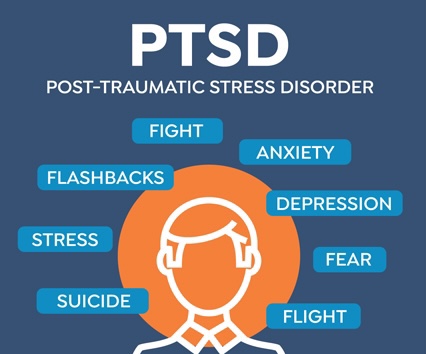
I hate PTSD, Anxiety and Depression

Retrieved from: https://www.google.com/amp/s/willingways.org/ptsd/%3famp=1https://www.google.com/amp/s/willingways.org/ptsd/%3famp=1

So, part of this whole “starting over” is accepting the fact that at my age, I have PTSD. anxiety and depression. I hate it. If you seen me in a day where I’m having an episode, you would think I was bipolar. The mood swings themselves are a headache. The sweats then getting cold during and after the anxiety attack, the chest pains from the panic attacks…it’s your own living hell. That’s not to mention the memories that flare up at the worst times. During one of these episodes, it’s hard to distinguish between reality and fiction.

So, let’s back up. Recently, I was diagnosed (rediagnosed) with PTSD and manic depressive disorder between these two, it sets off panic attacks (anxiety attacks). What does PTSD mean? It means that I have post traumatic stress disorder. Trauma that happened in my past (from childhood into adult years and throughout adult years). With PTSD, there are many triggers, or things that cause you to go back in time mentally. It can be a smell, a sound, a tone, a person, a season, the way someone speaks to you…it can literally be anything that brings up the memory of that traumatic experience.

To have a panic attack means that my heart starts racing, I go into what’s called fight or flight mode (I tend to go into flight mode more often that fight), it can mean that my chest starts hurting mimicking a heart attack…it can also mean that I get shaky, restless and can not sit still. Part of all of this also means I have a difficult time focusing on anything outside of what I’m feeling or tend to be very forgetful.

Having these constant battles daily also means I don’t sleep well at night, I find it difficult to trust anyone, especially males (although I recognize that not everyone is the same), and it makes my relationships more challenging, friendships or romantic.

Having Manic depressive disorder means that I have a lot of down days…more often than not. It means I’ve lost a lot of the joy I once had, I feel down on myself more frequently than not, I feel sad more frequently than others. Overall, I tend to have an u realistic expectation of myself which causes me to feel down when I can not achieve goals that I’ve placed for myself or that’s been expected of me from others in my past or present.

Continue reading “I hate PTSD, Anxiety and Depression”
Design a site like this with WordPress.com
Get started